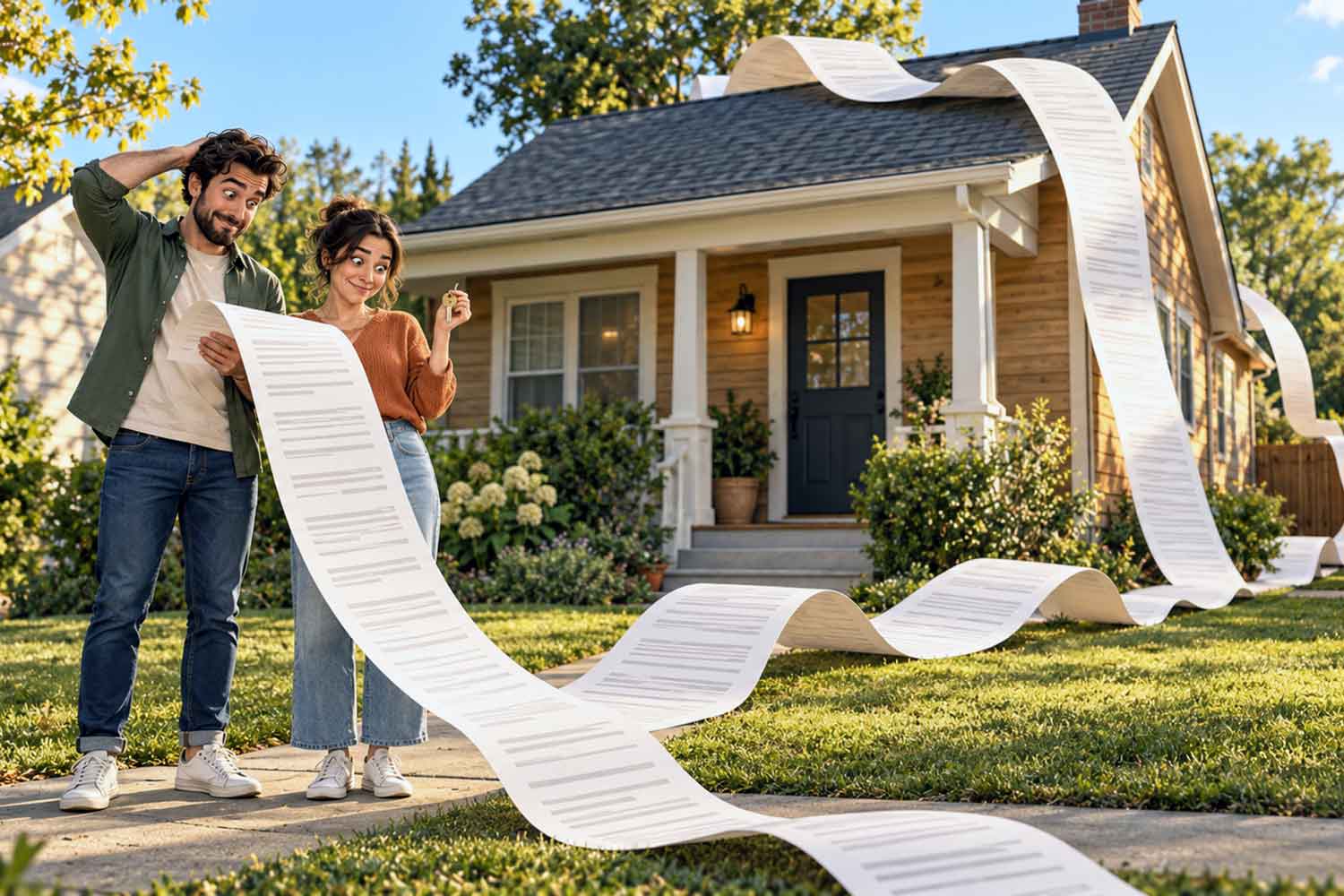
The starter home has become one of the most confusing species in residential design. It is described as “entry-level,” which is real-estate language for “you may enter after selling a kidney, a vintage watch, and your hopes of retiring at 62.”
It used to mean a modest first house: a roof, a kitchen, perhaps a bedroom where two people could stand at once without negotiating a traffic plan. You bought it, painted a wall an adventurous shade of beige, and slowly improved it while learning that gutters are not decorative.
Now the starter home is a 2,700-square-foot executive residence with a spa ensuite, a wine room, a three-car garage, and an outdoor kitchen. The listing calls it “perfect for first-time buyers.” The first time buyer would like to know whether “first-time” means the first time they have personally purchased a home or the first time their family has pooled assets since the Gold Rush.
Small homes, big expectations
Somewhere along the way, we decided that a house could not be considered complete unless it contained every room ever invented. The wish list arrives with a confidence usually reserved for people who have never seen a construction estimate.
“We’d like three bedrooms, two-and-a-half bathrooms, a home office, a gym, a media room, a guest suite, a mudroom, a walk-in pantry, and a quiet place to take calls.”
“How many people will live there?”
“Two. We both work downtown.”
At this point, the designer gently asks whether the home office could also be the guest room, the gym could be a pair of walking shoes, and the media room could be the living room with a television. This suggestion is received as though the designer has proposed replacing the roof with a tarp.
Good small-home design is not simply making everything smaller. It is making the space work harder. A compact entry can still catch muddy boots. A dining area can double as a desk without requiring a furniture-based hostage negotiation. A well-placed window can make a room feel generous without adding another 400 square feet and a second mortgage.
The square-footage arms race
There is a peculiar belief that square footage is a personality trait. Ask how large a house is and people answer in the tone usually reserved for marathon times. “Only 2,400.” Only! That is enough room to lose your phone, find it, and lose it again in a different wing.
Meanwhile, the actual cost of a home is shaped by much more than its floor area. Land, servicing, permits, structure, labour, materials, and the local rules all show up to the budget meeting with their own invoices. That is why a smaller home is not automatically cheap, and why squeezing a large wish list into a tiny footprint can produce a home that feels like a very expensive game of Tetris.
There is also the “while we’re at it” effect. “While we’re at it, could we add a vaulted ceiling?” Of course. “And a covered deck?” Certainly. “And could the covered deck be heated, screened, wired for speakers, and large enough for a twelve-person sectional?” By now the starter home has quietly become a boutique resort with a mortgage that has started its own podcast.
Starter home or starter palace?
Maybe the answer is not to ban nice things. Nobody wants to live in a damp shoebox with one outlet and a view of the neighbour’s recycling bins. A home should be comfortable, durable, and pleasant to come back to. The trick is knowing which features matter every day and which ones are mostly there to impress a person who visits once, says “wow,” and then leaves before the cleaning begins.
Spend on the things you touch and use: a kitchen that works, storage where it is needed, good natural light, quiet bedrooms, durable finishes, and a layout that makes daily life easier. Think carefully before spending heavily on the room whose main function is to prove that you own a room whose main function is to prove that you own a room.
And if the budget is tight, design for the life you have, with a little room for the life you might have. A flexible room can be an office now, a nursery later, and a hobby room after the child discovers that the violin is “not really their thing.” That is more useful than building a dedicated room for a future you saw in a lifestyle magazine and have never actually met.
A modest proposal
Let’s bring back the starter home as an idea: not a tiny house, not a luxury mansion wearing a fake moustache, but a thoughtfully designed home that lets people get started. Give it a sensible footprint, an adaptable plan, enough storage, good light, and a price that doesn’t require a family summit moderated by a forensic accountant.
We might even stop calling every modest home “cozy.” Cozy is lovely when it means a warm blanket and a cup of tea. It becomes suspicious when it means the refrigerator door can only open if the bathroom door is closed and one resident briefly steps outside.
The ideal starter home should be simple enough to afford, smart enough to grow with its owners, and attractive enough that nobody has to say, “Well, at least it’s a good investment.” It should start a household’s next chapter—not a thirty-year game of financial Jenga.